What Makes Sophie, Sophie?
Sophie grew up in Devonport, Tasmania - on Palawa Kani country - and she still loves it down there. Here's how she describes herself:
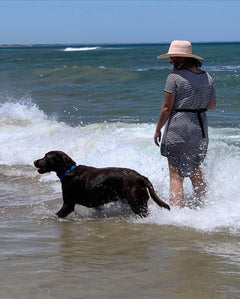
I was always interested in nature and animals. I used to love long beach days, and still do! I truly appreciate how untouched the Tassie landscape is.
Now I spend my weekends walking my beautiful dog and watching movies with family and friends. I love baking cakes and sweets and generally just like to make a huge mess in the kitchen. Luckily, I have a great husband who cleans it all up.
When we go on holidays we like to visit family in Queensland, spending time on the Gold Coast (the land of the Kombumerri families of the Yugambeh Language Region) and then driving up to Tannum Sands (Goeng Land). We always stop off at Noosa (Kabi Kabi Land) on the way, of course. It's a pretty great spot!
My favourite musician of all-time is a guy called Phil Collins. If you don't know him, please, do yourself a favour and have a listen. He wrote and composed all the music to Disney's movie, Tarzan. Check it out!
As a kid, I always enjoyed problem solving games like building things with Lego and Meccano, or playing puzzles and memory games. As an adult, challenges still interest and fulfil me. These challenges are very different now. Instead of building Lego, I might deconstruct and clean a microscope to help it operate more effectively. Instead of puzzles and memory games, in my free time I play games on my Nintendo Switch.
Sometimes, it feels like I create the problems that need solving, but that's okay, as long as I'm asking important questions and showing courage and passion for my work. Do you agree?
What Does A Biological Scientist Actually Do?
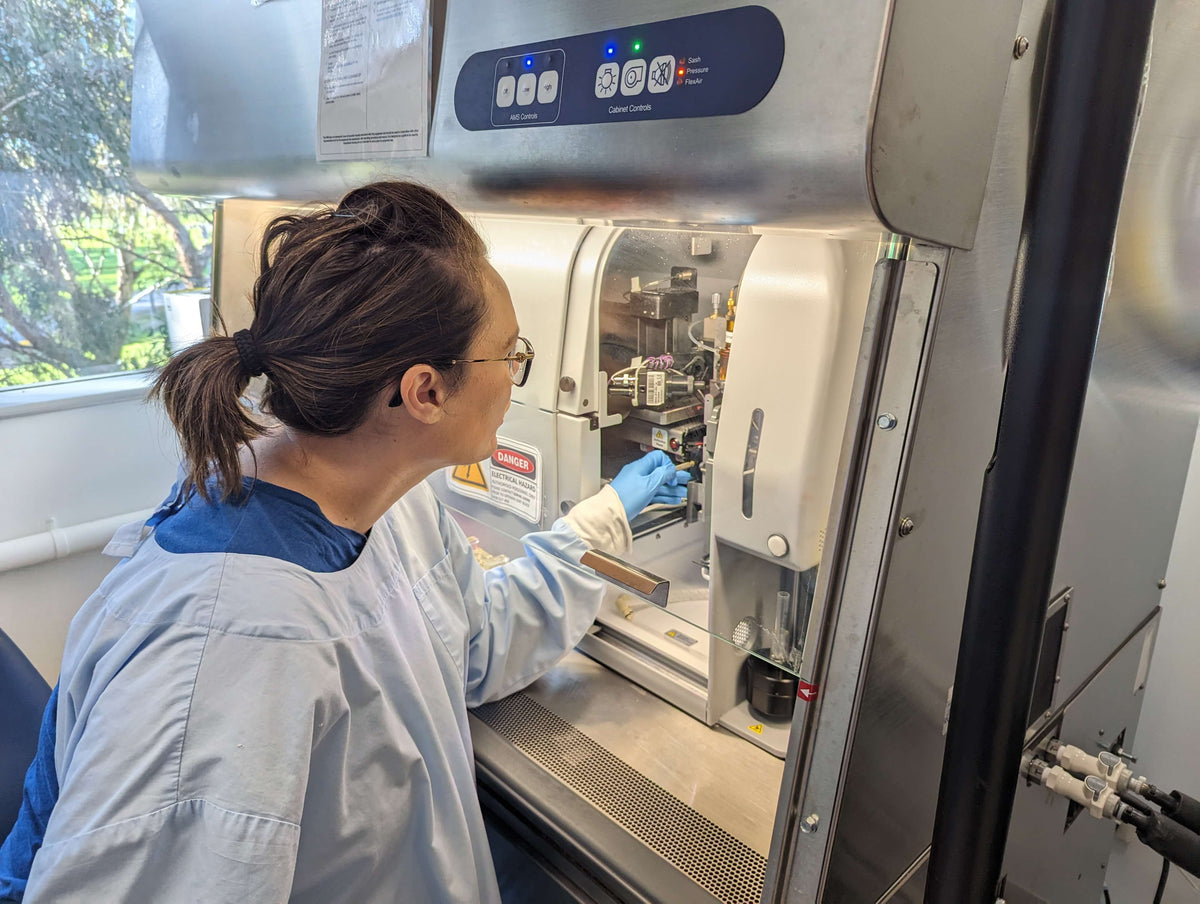
As a technical officer in a biological science lab, I spend my days supporting research staff and students. I give advice on experiments and train people to use techniques like flow cytometry, next generation sequencing and tissue culture in their research - things I didn't even know existed when I was at school!
There's a lot of safety and ethical rules that need to be considered in science, so I also help make sure that everyone feels safe and well-informed in the laboratories.
There are boring and tedious parts of my job, like in every job (and probably your school work too), but there are really challenging and exciting parts as well. I feel like I have a great balance between these two, which is important in helping me feel fulfilled and happy.
How Did Sophie End Up In A Science Lab?
Sophie didn't come to science straight out of school. She worked a few different jobs first.
I worked in a jewellery shop in Tasmania for a while, then I moved up to the Whitsundays and worked in a resort. It was pretty great up there. You should definitely research the Whitsundays and talk your family into going on a holiday there!
After that, I moved to South Australia and worked as a travel agent, booking holidays and flights for people. All of these jobs were fun and seeing different parts of Australia was great, but they weren't really for me. They didn't have that problem solving aspect that was so important to me.
As an adult, I looked into going to university and I poured over the booklets (yes, back then it was in booklets - not online!) deciding which degrees appealed to me. I decided that a Bachelor of Science (Molecular Biology) was the right fit for me.
I found studying at university incredibly challenging, but, like I said, I do enjoy challenges. There was so much to learn and it was stressful at times. I had some great teachers that made the learning so much more fun than it could have been.
After I graduated, I started a research role. It was fantastic! There was problem solving, it was challenging and busy - everything I had dreamt of! But, after a few years, our funding ran out and I transitioned into research support roles. It was in these roles that I learnt about flow cytometry and next generation sequencing, which is what I still do now, but instead of learning, I do the teaching!
What Is Sophie Most Proud Of?
Earlier this year, a scientific journal article was published on my work as a researcher. It felt like a resolution to years of hard work and intense problem solving. It was so satisfying to see it published with my name on it. That has been my proudest moment as a researcher.
As a support officer, I've developed training packages for several techniques. I always get fantastic feedback from research leaders and students alike. This instils me with a lot of pride and confidence and inspires me to continue in this field.
Personally, it's been a huge 12 months of achievements for me - my partner and I got married last year (yay!) and we are now expecting our first child which we are both so very excited about. I have no doubt this will be my most challenging project yet!
Wait, What Are Those Things Sophie Mentioned?
Sophie talks about flow cytometry, next generation sequencing, and tissue culture. Big words. Here's what they actually mean.
Flow cytometry is a way of analysing tiny particles in a fluid, like blood or saliva. Scientists use it to learn about the cells inside a person's body. It can count immune cells, find cancer cells, or even look at DNA. Pretty important stuff.
Next generation sequencing (NGS) is a technology used to read DNA and RNA. It can sequence thousands of genes - or even a whole genome - in a really short time. It's used to spot genetic differences in humans, animals, and plants.
Tissue culture is a tool for studying cells from living things. Scientists grow tissue in a lab so they can experiment on it and learn how it works. It means they can explore the tissue of plants, animals, and even humans, without needing the whole organism in front of them.
Got questions?
-
Sophie didn't go straight from school to uni. She worked in a jewellery shop, at a Whitsundays resort, and as a travel agent first. She found uni really challenging when she eventually went, but she liked the challenge. Being good at school helps, but being curious and willing to keep going when things get hard matters more.
-
Lego, Meccano, puzzles and memory games. She still loves problem solving as an adult - she just does it on bigger problems now, like fixing microscopes or training researchers. The same kid stuff, grown up.
-
Yes. Notice things. Ask why. Pull something apart that's already broken and see how it was put together. Watch ants for a while. Try to grow something from a seed and see what happens. Science starts as paying attention to the world.