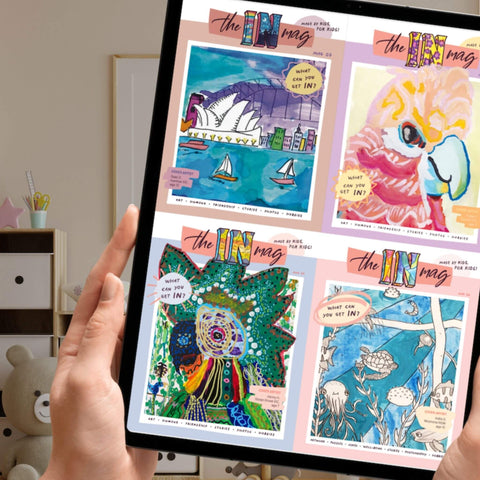
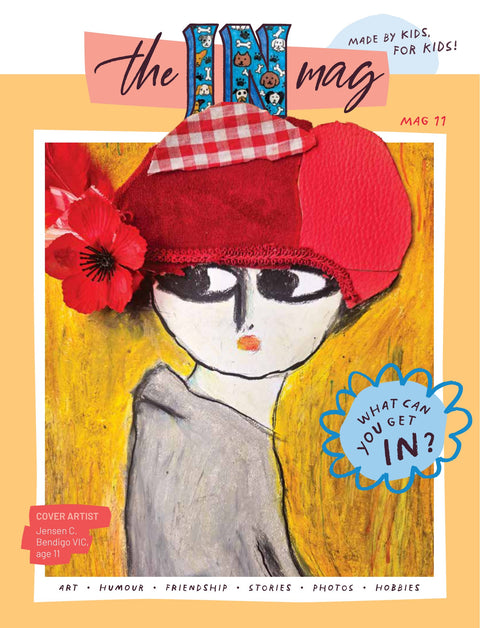
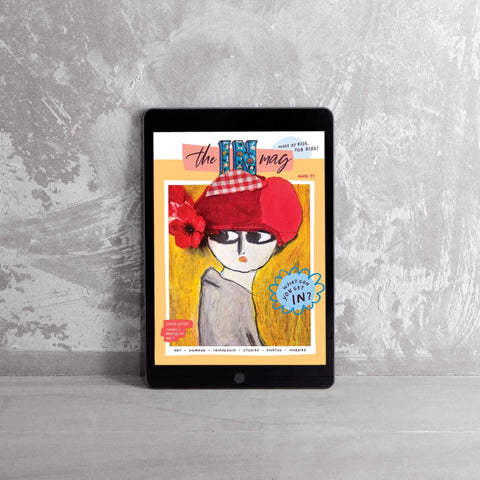
theINmag is a pretty special place. Kids get to see their creations in print, with their name on the page, in a magazine made for other kids exactly like them. That's the whole joy of it.
Because our submissions come in online, we take every possible precaution to keep the kids who send IN safe. Child safety is the number one pillar of how we make the mag. As teachers and parents ourselves, we take real pride in keeping the space kids are creating in a safe one.
Here's what that actually looks like.
Who actually makes theINmag?
Tam and I are the co-founders, and the magazine has been born out of years in the classroom as experienced primary teachers. We're also parents. The wider team that helps us curate, proof, and read submissions includes other teachers, parents, and working artists. Between us, there isn't a stage of the magazine that doesn't have someone with classroom experience looking at it.
Being a registered teacher carries a legal duty of care to every kid we deal with. In plain English, duty of care is the rule that says if we saw a kid in trouble walking down the street, it would be on us to help. The rule doesn't switch off when we close the laptop. It runs through every part of how we make the mag.
Most of what follows is just what that looks like in practice.
Why don't you publish kids' faces?
We never publish a kid's face inside the magazine. Not in the gallery, not in the photography spreads, not anywhere.
The safety reason for this is obvious. The bigger reason is the one we built the magazine on.
Kids' magazines that lean on faces end up looking like a smaller version of the celebrity-and-influencer world the kids are already swimming in. We didn't want that. We wanted the focus on what kids make, not what kids look like. When you open theINmag, what you see is the creation. The painting. The poem. The photograph of the kid's own dog. Their name appears. Their face does not.
A kid gets to be known for what they made. That's the whole point.
Why no ads?
theINmag has zero advertising in it. No sponsored spreads. No "this issue is brought to you by." No banner across the bottom of the photography page.
That's a safety call, not just an editorial one. Ads in kids' media are the mechanism that quietly shifts the kid's attention from "what could I make" to "what could I have." They're the same pull as the influencer feed. We didn't want to spend 200 pages teaching kids to look at creations and then sell those same kids something on page 201.
Here's the honest reality of that choice. The vast majority of magazines run on ad revenue. It's often the bulk of what keeps them in print. We've chosen not to play that game, which means sales are the only way we sustain ourselves and grow. So when a parent tells another parent with a creative kid about theINmag, it genuinely matters. Word of mouth is what lets us keep the pages ad-free for the kids who flip through them.
A kid reading theINmag is looking at other kids' creations the whole way through. Their own creative head stays in the room.
What information do you collect from kids?
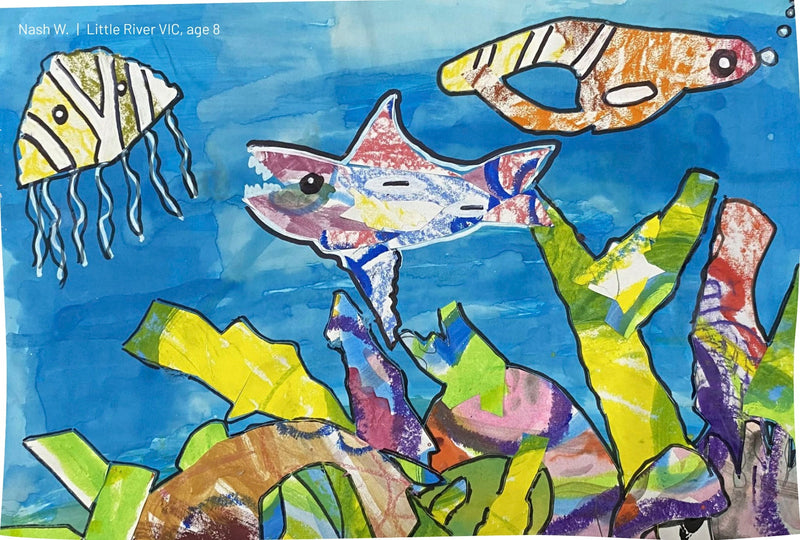
When a kid sends IN a creation, we ask for four things: first name, last initial, age, and town. So a contributor reads in the magazine as "Eli K., age 8, Castlemaine VIC."
No full surnames. No email addresses from kids. No phone numbers. No school names. No street addresses. The form doesn't have the fields, because the magazine doesn't need them.
We do offer one optional field for a parent or guardian email. This is a new feature we're testing. It's the parent's email, never the kid's, and it does one job: it lets us reach out to the parent before the next issue launches to let them know if their kid's creation will be in it. That's the whole purpose. We don't use it for marketing the kid. We don't share it. A parent can leave it blank and the submission goes through exactly the same way.
It also means we genuinely cannot identify a kid based on what's in the mag. "Eli K., age 8, Castlemaine VIC" is the most specific any reader ever gets.
Does every submission need a parent's okay?
Yes. Every time. Every submission needs consent from a parent or guardian before it goes near a page.
That's not a one-off tick at signup that carries forward forever. It's every send-IN. If a kid wants to send in three creations this term, mum or dad or whoever's at home needs to be in the loop three times. The form makes this explicit.
The reason we do it per-submission rather than once-and-done is simple. We want parents in the loop on what their kid is sharing online. Being a parent right now feels like a minefield - there's so much your kid could be sharing in so many places, and you can't be across all of it. We want theINmag to be the easy one. The place where you always know what your kid has put out into the world, because nothing goes out without you. Transparency is the whole game.
How do you decide what goes in?
Every submission is read by a real person before it goes anywhere near a page. The team is a mix of teachers, parents, and artists, and their job is to read with safety in mind first and creativity second.
The tricky part of what we do is the age range. theINmag gets sent IN to by kids from age five all the way up to fifteen. So when we read a submission, we're not just asking "is this a great creation." We're asking how a younger kid would read this. How an older kid would read this. Whether anything in the background of a photo could be used by a stranger.
We had a girl from a small town in central Victoria send in a photograph of her backyard at sunset. Genuinely beautiful piece of photography. We didn't run it. Not because of anything she'd done, but because the open paddock and the back fence in the shot were specific enough that someone in that town could have worked out where she lived. The photo was a hundred percent her creation. The risk wasn't worth it.
That call gets made more often than you'd think. The kids never hear about the ones we don't run. From their end, the magazine is a place where they get to send IN, and the issue arrives.
What happens if something more serious comes through?
This is the heavier part, and we'll keep it short.
Teachers are mandatory reporters. That means there are specific categories of concern where we are legally required to pass information to the relevant authority. We hope we never have to. If we ever do, we will. Being experienced teachers is what makes us able to tell the difference between something unusual and something genuinely worth following up.
You won't hear about this side of the mag in the pages. That's how it should be.
So what does all of this mean for your kid?
When a kid sends IN a creation to theINmag, here's what's true. A parent has said yes. An experienced teacher has read the submission. Their face is never going to appear. Their full name is never going to be asked for. The magazine they're sending into has no ads in it. And maybe, the part the kid actually cares about, the creation lands in the next issue, and they get to see their name in real ink with their creation on the page.
Child safety is the number one pillar of how theINmag gets made. It's the value we hold ourselves most accountable to, in every decision, on every page. Everything else the magazine offers - the printed pages, the kid seeing themselves in print, the parents who frame the spread, the issues that pile up on the coffee table - all of that exists because the pillar holds.